7 Hiring Mistakes to Avoid When Recruiting Aerospace Power & EMI Engineers
1️⃣ The Resume Illusion: Keywords ≠ Competence
Most aerospace job descriptions contain:
- DO-160
- MIL-STD-461
- EMI/EMC
- 28V / 270V DC systems
- Power conversion (DC/DC, AC/DC)
- Thermal analysis
- High-reliability layout
- The problem?
- Candidates know these keywords.
But many have:
- Supported testing (not owned architecture)
- Followed legacy layouts (without understanding current return paths)
- Executed small blocks, not full system design
- Worked in automotive/commercial environments with very different compliance realities
- The gap only becomes visible during:
- Preliminary Design Reviews (PDR)
- Critical Design Reviews (CDR)
- EMI pre-scan failures
- Late-stage qualification surprises
By then, the cost is already high.
2️⃣ EMI Is Where Hiring Mistakes Show Up
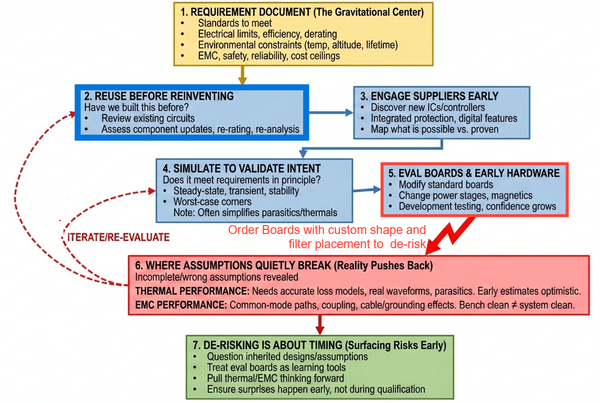
In aerospace programs, power conversion rarely fails functionally.
It fails in EMI.
Common patterns
- Overreliance on COTS bricks without layout ownership
- Poor high di/dt loop control
- Inadequate grounding architecture
- Shield termination handled as an afterthought
- Filter design treated as patchwork after pre-scan failure
Engineers who have only “supported” DO-160 testing often cannot defend:
- Section 16 conducted emissions strategy
- Category Z transient margin decisions
- Installation-dependent tradeoffs
- Shielding vs. filtering decision logic
You don’t discover this during resume screening.
You discover this during failure.
3️⃣ The Brick vs. Discrete Trap
Program pressure often drives early architecture decisions:
- Bricks for schedule speed
- Discrete for efficiency/optimization
The hiring mistake happens when:
A candidate can design one, but doesn’t understand the systemic tradeoffs.
Bricks are not immunity against:
- Conducted emissions
- Common-mode noise
- Thermal density constraints
- Integration coupling issues
- Discrete solutions are not automatically “better” without:
- Proven layout discipline
- Filter tuning strategy
- Margin to worst-case line/load
A senior aerospace power engineer must be able to justify architecture decisions in front of certification authorities and system leads.
That bar is much higher than commercial electronics.
4️⃣ Automotive ≠ Aerospace (And That’s Okay)
Many candidates transitioning from automotive are strong technically.
But differences include:
- Transient profiles
- Qualification philosophy
- Documentation rigor
- Failure mode accountability
- Installation-dependent EMI behaviour
The mistake hiring teams make is assuming:
“High-power automotive experience transfers 1:1.”
Sometimes it does.
Often it does not without adaptation.
Screening must probe:
- Certification exposure
- Test-failure recovery experience
- Design review defensibility
- Cross-disciplinary collaboration history
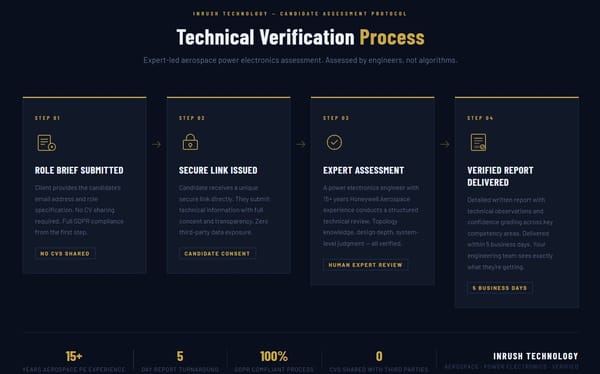
5️⃣ HR Filtering Cannot Catch This
Most internal HR teams are capable and diligent.
But they are not power electronics engineers.
They rely on:
- Keywords
- Years of experience
- Degree signals
- Agency submittals
That model works for general engineering roles.It breaks down for:
- High-voltage power
- EMI ownership roles
- Architecture-level accountability
- Aerospace compliance environments
Because the difference between:
“Has seen DO-160”
and
“Can defend a DO-160 strategy”
is not visible on LinkedIn.
6️⃣ Why Agencies Struggle in This Niche
Generalist recruiters optimize for:
- Volume
- Speed
- Resume flow
- Interview placement metrics
They rarely:
- Run technical screening at depth
- Challenge EMI narratives
- Evaluate layout ownership
- Understand Cat Z implications
As a result, hiring managers lose time reviewing resumes that are technically misaligned.
The real cost isn’t recruiter fees.
The real cost is engineering manager time.
7️⃣ What Actually Predicts Success in Aerospace Power Roles
In my experience, strong candidates can:
- Explain current return path control on a whiteboard
- Defend their filter design strategy
- Describe a failed EMI event and how they fixed it
- Discuss installation dependency without deflecting
- Speak in terms of margin and certification logic — not just efficiency numbers
If they cannot discuss:
- Worst-case line/load
- Transient suppression philosophy
- High-frequency loop geometry
- Shield grounding methodology
They are not ready to own aerospace power architecture.