
Technical Verification for Aerospace Power Electronics Candidates
Verify what automated tools and generalist recruiters cannot. Expert-led technical assessment by engineers who have done the work.
I have worked for past fifteen years in the power electronics filed in Aerospace , automotive and datacenter. Developing various converters like multiphase POL to LLC resonant DC/DC converter to 500KW inverters that is used in mass production.
Verify what automated tools and generalist recruiters cannot. Expert-led technical assessment by engineers who have done the work.

1️⃣ The Resume Illusion: Keywords ≠ Competence Most aerospace job descriptions contain: * DO-160 * MIL-STD-461 * EMI/EMC * 28V / 270V DC systems * Power conversion (DC/DC, AC/DC) * Thermal analysis * High-reliability layout * The problem? * Candidates know these keywords. But many have: * Supported testing (not owned architecture) * Followed legacy layouts (without understanding current return
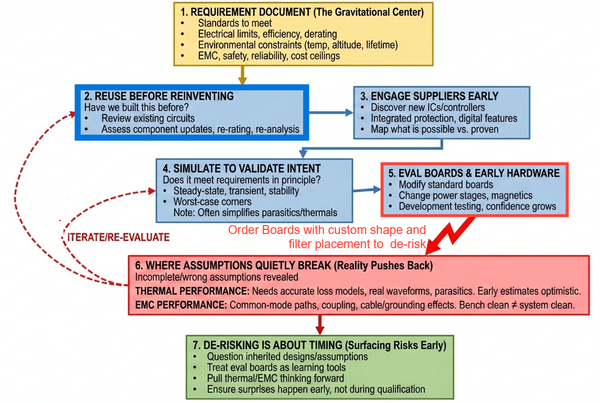
You learn 100x more from a real hardware prototype than you ever will from a perfect theoretical analysis or a month of simulations. To fast track schedule, you have to embrace the SpaceX philosophy: build early, test to failure, improve. Get Your Early Power Architecture Validation These boards are built
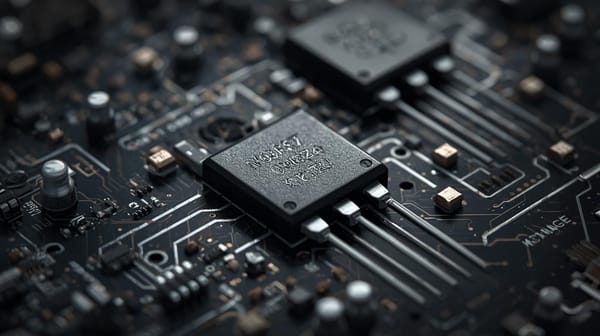
When designing power electronics, the Safe Operating Area (SOA) graph is your boundary between a reliable design and a catastrophic failure. This chart indicates the maximum power a device can safely handle before failing. What is Linear Mode? While MOSFETs are often used as simple switches, many applications—like soft

Aircraft Power Requirement Tool DO-160 Section 16 and MIL-STD-704 (Aircraft) Standard Comparison DO-160 Section 16 (DC) MIL-STD-704 DO-160 AC Input Select Category: Category A Category B Category C Category Z PARAMETERREQUIREMENT PARAMETERMIL-STD-704 (AIRCRAFT) REQUIREMENT Select Category: Category A Category B Category C Category Z PARAMETERREQUIREMENT The 16V Trap: Many '
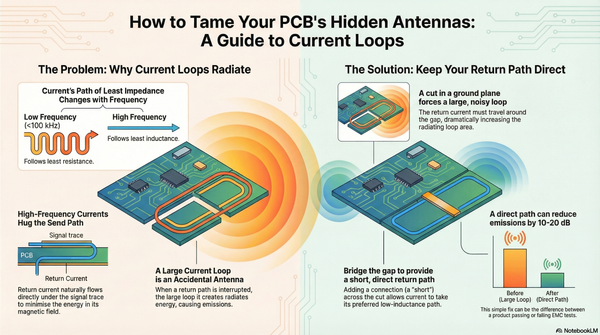
Introduction: The Hidden World of Your Circuit Board Most EMC failures aren't caused by bad circuit math; they are caused by "invisible" antennas created by poor layout. If your design works on the bench but fails at the lab, you have a current loop problem. --------------------------------------------------------------------------------